
Survival Mode
AN EXCLUSIVE INTERVIEW WITH SHANNON NIEMAN
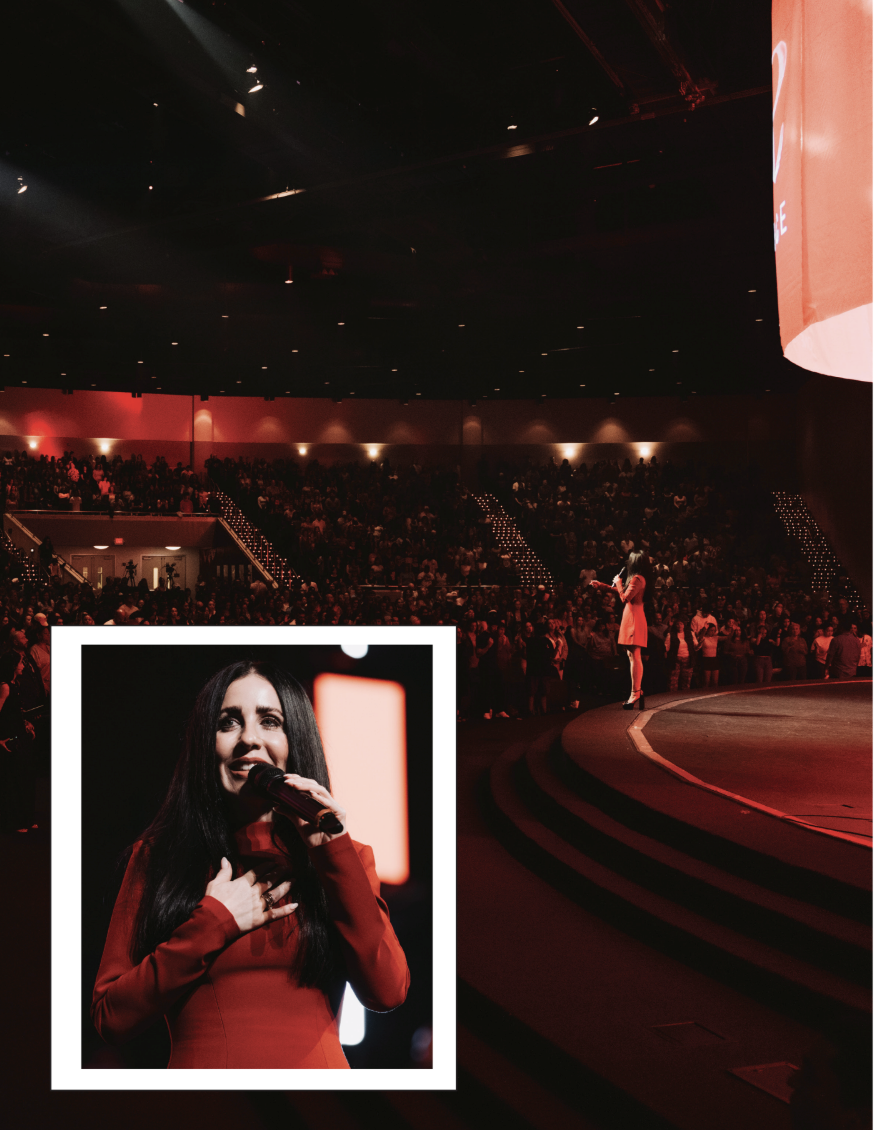
She’s waiting to go on stage, the lights are about to rise, and thousands of women are waiting in the auditorium. In the final moments before she walks out, Shannon Nieman is pro- cessing more than just the microphone in her hand. She has just gotten off the phone with her lawyer. A custody situation is unfolding. Her marriage has been fracturing for years. Grief still comes in waves from her mother’s passing. And this is not a single bad season. It is years of one hit after another. And still, in ninety seconds, she will step into leadership.
That was not a dramatic story crafted for a stage. That was her real life. And it is the emotional ground zero of Survival Mode, Nieman’s forthcoming book built for the woman who cannot pause her life to heal, the woman who is awake at 2 a.m. seeking the answer to the burning question in her soul, “What do I do today?”
Nieman, founder of One Sisterhood, speaker, author, and the lead pastor at Abundant Church based in El Paso, Texas, has become known for a message that is both faith-forward and practical, anchored in spiritual truth and supported by real tools that help women overcome crisis. In an exclusive conversation, she opened up about grief, leadership, single motherhood, the tension between surviving and thriving, and the disciplines that help keep a woman together even when her life feels as though it is collapsing.
“I’ve been doing church my whole life,” Nieman shared. “I was born into that.” Raised by pastors who began their ministry as a home Bible study. For a season, she attempted a different trajectory. Law school felt ambitious and respectable. She took the LSAT, planned for Pepperdine, and began an internship at a major firm. “Six weeks in, I was like, I am going to be the worst lawyer in history. I am not wired for this.” The realization was unmistakable. When she told her parents she would not be attending law school, they simply said they already knew. What appeared to be a career detour was, in truth, a step toward the calling that had always been on her life. Not long after she married, her life suddenly shifted. A scan revealed a mass in her mother’s abdomen. Within days, they were at Northwestern Hospital in Chicago facing what doctors believed was advanced cancer. The morning they prepared to fly out, Nieman took a pregnancy test. It was positive. That same week, as her mother lay in ICU recovering from surgery, Nieman began cramping intensely. A nurse, heaven-sent in that fragile moment, toldher she was miscarrying and helped her receive immediate care. Alone in a hospital bathroom, she prayed through tears, “God, I’m begging you, if I’m actually pregnant, please make this baby stay.” She later shared, “No one knew I was expecting.”
Her daughter, Emery, would be carried through the duration of her mother’s battle. For nine months, Nieman moved between oncology appointments and prenatal checkups, hospital rooms and much prayer. When doctors told her that her mother had only two weeks to live, Nieman made the decision to induce. She wanted to be by her side in hospice. After hours of labor, Emery was ultimately delivered by emergency C-section. Less than twenty four hours after giving birth, her request to be discharged was miraculously granted so she could return home. It was an answered prayer that her mother was able to hold baby Emery in her arms. The next day, on a Sunday morning, she passed away. “I knew the moment my mom went to be with the Lord,” Nieman said. “I was holding her hand. I felt it.” In the next room, her newborn began to cry at that exact same moment. It was in that moment she experienced what she now describes as simultaneous truths: endings and beginnings sharing the same breath, joy and sadness coexisting at the same time.
The years that followed required composure in public and resilience in private. Small fractures in her marriage that had begun during her mother’s illness grew wider, and eventually the marriage ended. The custody process that followed was difficult and drawn out. The responsibilities of leadership did not pause.
“When you grow up in the spotlight, and there’s this belief that you cannot be a pastor and be divorced, there was so much,” she said. Shame pressed in. So did fear. Yet she refused to accept the narrative that survival is weakness. She explains, “Surviving is not negative.
Surviving is not surrendering.
I look back, and I think there was an
opportunity for me not to survive. That
would have looked like: I’m no longer a
pastor. I’m no longer a leader. One Sister-
hood is not created. I surrender all of the
giftings, talents, and abilities that God
put on the inside of me because my mind
and people were telling me I was no lon-
ger going to belong in this space.
Surviving was this: “You know what?
This is not what I wanted. This is not
what I believe God wanted. But this is
what’s happening, and I’m not going to
surrender everything else in my story
and everything else in my life to this.
I have to accept this, and I have to get
through it. But I’m going to keep being
who I am, and who God created me to
be.”
In the powerful framing she both teaches
and has personally exemplified through-
out her testimony, sur-
vival mode is not col-
lapse but discipline.
It is the decision to
protect what remains
steady while rebuilding
what has broken. It is
trusting that what feels
like unraveling is not
the final word, because God’s promises
remain true. As Scripture reminds us
in Jeremiah 29:11–13, ‘His plans are to
prosper you and give you a future filled
with hope. Then you will call on me and
come and pray to me, and I will listen to
you. You will seek me and find me when
you seek me with all your heart.’
At the center of Survival Mode is the
question women ask her most often in
moments of crisis: “But what do I do
today?” Her response is neither abstract
nor sentimental. Crisis narrows perspec-
tive and convinces you that everything
is falling apart, even when parts of your
life are still intact. She explains that the
first task is clarity: recognizing that not
everything is lost. The second is action
and compartmentalization. “You have
to get up, get dressed, go to work, and
do it well,” she says. “If you’re about to
be a single mom, the last thing you need
is not being able to pay your rent.” It is
not a message built on retreat or escape.
It is built on movement. Pastor wisdom,
therapist tools, and the candor of a trust-
ed friend converge into something prac-
tical enough to carry a woman through
courtrooms, offices, and even her kitchen
table.
What began as a vision, birthed in resil-
ience, has since grown into one of the
largest women’s ministries in America,
with conferences drawing more than
4,000 women at a time. One Sisterhood
has expanded into a space of empower-
ment and tangible support for women
navigating grief, divorce, abuse, and re-
building. In addition to the events that
provide community and spiritual suste-
nance, some of its most meaningful work
happens quietly, helping women leave
abusive situations, secure legal protec-
tion, find housing, and establish safety
for themselves and their children. It is
love expressed in action, an embodiment
of the hands and feet of Jesus in real time.
Shannon Nieman has become a champi-
on for women, urging them to dig deep
and anchor themselves fully in God. Her
message remains steady despite what
may feel like unsteady times: “You can
get through this, and you do not have to
do it alone.”
By Tricia Love Trujillo
